
Inside a 10-Day Vipassana Meditation Retreat: My Decade-Long Journey Toward Stillness and Self-Compassion

Updated: 2 days ago
Have you ever wondered what really happens inside a 10-day Vipassana meditation retreat?
No phone. No talking. No exercise. No dinner. Just you — sitting, walking, breathing, observing — hour after hour, day after day.
It sounds simple, even peaceful. But in reality, it’s one of the most humbling, raw, and transformative experiences a person can go through.
I’ve been practicing Vipassana meditation since 2012, and over the years, I’ve attended retreats in Myanmar (Burma), Thailand, and Germany — each deepening my understanding of the mind, and of myself.
Let me take you behind the scenes — to show what actually happens in these retreats, what I’ve learned, and why I keep returning again and again.
🌏 My Vipassana Journey — From Burma to Thailand to Berlin
My first retreat was in Panditarama Forest Monastery in Yangon, Myanmar — founded by the highly respected Sayadaw U Pandita, a leading figure of the Mahasi Sayadaw tradition.
It was there that I first learned the method of moment-to-moment awareness, noting sensations, thoughts, and emotions with mindful precision.
Later, I continued my training in Chiang Mai, Thailand, at Wat Ram Poeng (Tapotaram), following the lineage of Venerable Phra Ajahn Tong Sirimangalo. This tradition emphasizes a balanced integration of walking and sitting meditation, paired with daily teacher check-ins and Dhamma reflections.
Today, I continue my practice at a meditation center outside of Berlin, which follows Ajahn Tong’s lineage — a beautiful meeting point between Eastern wisdom and Western accessibility.
Over time, I’ve also met practitioners from the Goenka tradition and other Vipassana schools. While techniques differ slightly — in phrasing, pacing, or structure — I’ve come to believe, as the Chinese saying goes:大道至简,大同小异 — “All great paths are simple, and though they appear different, they ultimately lead to the same truth.”
No matter which lineage you follow, the essence is the same: seeing things as they really are.
What Is Vipassana Meditation?
The word Vipassana means “to see things as they truly are.”It is one of the oldest meditation practices in the Buddhist tradition, originally taught by the Buddha over 2,500 years ago as a path to liberation from suffering.
Unlike relaxation or visualization practices, Vipassana is about direct observation — watching sensations, thoughts, and emotions as they arise and pass, without reacting to them.
You learn to witness impermanence (anicca) — the fact that everything changes — and in doing so, loosen your attachment to pleasure, pain, and ego.
The 8 Precepts: A Foundation for Clarity
During a traditional 10-day Vipassana retreat, participants follow eight precepts to simplify life and purify the mind:
Abstain from killing — Practice non-harm toward all beings.
Abstain from stealing — Respect what is not freely given.
Abstain from sexual activity — Focus energy inward, not outward.
Abstain from false speech — Maintain noble silence.
Abstain from intoxicants — No alcohol, drugs, or caffeine after breakfast.
Abstain from eating after noon — Light dinner replaced with rice milk or chocolate.
Abstain from dancing, singing, or adornment — Simplicity supports awareness.
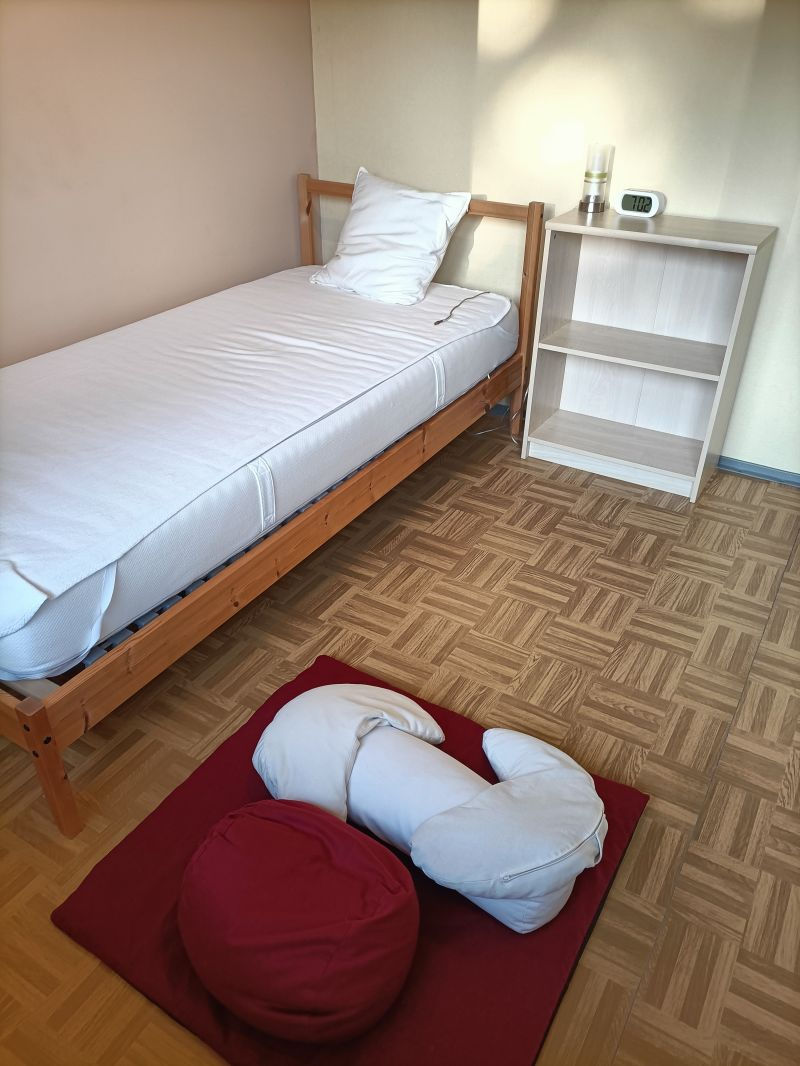
Abstain from luxurious beds or indulgent comfort — Sleep simply, live mindfully.
These precepts aren’t punishments — they are supports. They strip away distractions and bring you face-to-face with your habitual cravings and aversions.
A Day in Silence: The Daily Routine
Every Vipassana center runs on structure and discipline, creating a rhythm that carries you through the inner work.
Here’s what a typical day looks like:
🕓 4:00 AM – Wake-up bell
🧘♀️ 4:30–6:30 AM – Morning meditation
🥣 6:30 AM – Breakfast
🚶♀️ 7:00–10:30 AM – Alternating sitting & walking meditation
🍚 11:00 AM – Lunch (the main meal of the day)
🌿 12:30–5:00 PM – Work meditation (cleaning, gardening, serving, etc.), then more sitting/walking meditation
🍵 5:00 PM – Light drink (rice milk or small piece of chocolate)
🧘♀️ 5:30–9:00 PM – Evening meditation, individual talk with teacher, or group learning of Dhamma class
🌙 10:00 PM – Sleep
Simple life, repetitive rhythm — but within it, a universe unfolds.
The Challenges: Where the Real Practice Begins
Every retreat humbles me anew.
No coffee after breakfast.
No physical exercise, no stretch, no yoga.
No phone, no TV, no books, no talking.
No dinner.
Just sitting, walking, breathing, and being.
Here’s what actually happens when you strip life down like this:All the inner noise you’ve been too busy to hear starts speaking.
During my first few retreats, I faced wave after wave of resistance — fatigue, frustration, boredom, restlessness, anxiety, avoidance, irritation, self-doubt, and even resentment.
At first, I thought I was doing it wrong. Later, I realized:
These were not obstacles to meditation. They were the meditation.
By learning to observe instead of react, I began to see my own mental patterns clearly — the same ones that once drove me to burnout.
Learning #1: The Art of Noting — Awareness in Every Moment
When you feel sleepy, frustrated, or distracted, Vipassana teaches a method called “noting.”
You simply notice what’s happening, silently label it — “sleepiness, sleepiness” or “anger, anger” — and return to the breath.
No judgment. No fixing. Just presence.
This is powerful neuroscience in action.Labeling emotions activates the prefrontal cortex, the part of your brain responsible for regulation and perspective. It reduces the amygdala’s reactivity, helping you process stress more calmly (Lieberman et al., UCLA).
You realize that every mental state is temporary.You don’t need to suppress it or indulge it — only to observe it.
Learning #2: The Middle Way — Effort with Kindness
Meditation can burn you out too — not from sitting too long, but from pushing too hard.
In Vipassana, I learned to walk the “middle way”:
Effort, but not rigidity
Stillness, but mindful movement
Commitment, but with kindness
Whether in meditation or in life, forcing too much breaks you. Too little, and nothing grows.The art lies in steady, gentle effort — showing up fully, but softly.
Learning #3: Mindfulness Beyond the Cushion
Mindfulness doesn’t end when the meditation bell rings.
During retreats, daily “work meditation” (dāna) was part of our practice — from cleaning the kitchen to pulling weeds in the garden.
Those sweaty, humble moments became my favorite.Because mindfulness is not about closing your eyes — it’s about opening your awareness to every act of living.
When I offered food to the bhikkhunis, I learned gratitude in motion.When I worked under the sun, I learned humility and presence.When I ate, I tasted every bite with reverence.
Mindfulness became a way of being, not just a practice.
Learning #4: Compassion, Forgiveness, and Inner Healing
Meditation is not always peaceful.Sometimes, it opens old wounds — memories, grief, or self-judgment buried deep within.
In one session, I saw myself kneeling before my own heart, eyes full of compassion, saying:
“I’m sorry. I love you.”
Forgiveness — not as an idea, but a felt experience — washed through me.Years of inner criticism and perfectionism began to dissolve.
Another time, I found myself holding my inner child, massaging her tiny feet, laughing and crying as I gave her the love she had always longed for.That moment taught me: I no longer need to wait for love. I can give it to myself.
And when I heard the cries of cows from the nearby barn, I practiced metta, loving-kindness — sending warmth to them, to my parents, to those who hurt me, to all beings.
That’s when I realized gratitude isn’t about what’s perfect — it’s about embracing what’s imperfect, too.
Learning #5: The Noise Is Not the Enemy
As a sound-sensitive person, I used to wear earplugs during meditation — until my teacher gently said, “Try without them. Let the noise in.”
It was terrifying at first.
But as I sat and noted, “hearing, hearing,” something shifted.The sounds — birds, wind, footsteps, chickens — stopped being intrusions.They became part of awareness itself.
It’s not the noise that disturbs us — it’s our resistance to it.
When you let go of control, stillness reveals itself within movement.
Learning #6: Generational Healing and Acceptance
One profound realization came unexpectedly:The pain we carry toward our parents often isn’t just ours — it’s ancestral.
Through countless sits, I saw how patterns of fear, shame, and striving had been passed down through generations.
Instead of trying to “fix” them, I began to send love — silently, steadily.As one of my teachers said:
“To be truly free, we must first make peace with our parents — in our hearts, if not in reality.”
Since then, I’ve learned that peace doesn’t mean forgetting pain; it means acknowledging and releasing it with compassion.

Common Misconceptions About Vipassana
Before attending, I had many misconceptions — and I’ve seen others arrive with the same:
❌ “It’s about suppressing thoughts.”
✅ It’s about seeing them clearly and letting them pass.
❌ “You’ll have mystical visions or instant enlightenment.”
✅ You’ll mostly face your mind’s chaos — which is the path to insight.
❌ “It’s only for Buddhists.”
✅ Vipassana is non-sectarian. It’s a method for training awareness, open to everyone.
❌ “You have to be calm all the time.”
✅ Most of the time, you’ll feel everything but calm — until calm emerges naturally from acceptance.
Why I Keep Going Back
Each retreat strips another layer of conditioning.Each silence reveals a truth I didn’t know I was avoiding.
I return because it keeps me humble, clear, and grounded.Because it reconnects me to the wisdom that burnout once buried:That peace isn’t found by doing more — it’s found by being here.
Who This Practice Is For (and Not For)
Vipassana is for you if:
You want to understand your mind beyond thoughts and emotions.
You seek healing from stress, overthinking, or burnout.
You’re willing to sit with discomfort and let go of control.
It may not be for you right now if:
You’re in acute emotional crisis or trauma without support.
You expect it to be a “wellness retreat” — it’s more like mental bootcamp.
You’re looking for relaxation — you’ll find transformation instead.
🔗 If You’re Curious to Try
If you’re considering a Vipassana retreat:
Start with a few minutes of daily mindfulness practice
Read The Art of Living by S.N. Goenka
Research centers like Panditarama (Myanmar), Wat Ram Poeng (Chiang Mai), or Dhammanikhom (Germany)
And most importantly — come with an open mind, not expectations.
💛 Vipassana, Burnout, and Living Truthfully
After years of coaching professionals through burnout, I see this connection clearly:
Burnout doesn’t just happen from overwork or bad bosses.It often begins when we stop listening to ourselves — when our inner truth and outer life fall out of alignment.
Vipassana helps you realign — to pause, reflect, and rediscover what’s authentic and sustainable for you.
🌿 If you’re feeling drained, lost, or out of sync — maybe what you need isn’t to do more, but to pause and listen within.
I offer 1:1 burnout prevention and recovery coaching that blends mindfulness, imagework, and science-backed tools to help you reconnect with your energy and clarity.


Comments